
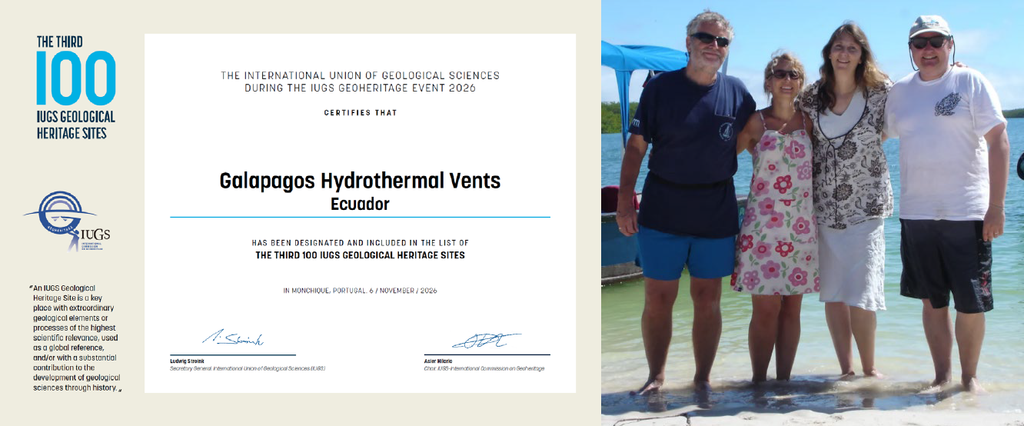
The International Union of Geological Sciences recognizes the site of the world’s first hydrothermal vent discovery, made during a 1977 expedition using WHOI’s submersible Alvin.
(November 6, 2026) – The site of the world’s first discovered hydrothermal vents, explored in 1977 by scientists aboard the human-occupied submersible Alvin, has been named one of the world’s most significant geological heritage sites by the International Union of Geological Sciences (IUGS).
IUGS Geological Heritage Sites are chosen for their outstanding scientific value as exceptional examples of geological features, processes, and discoveries. They represent some of the world’s most significant places for understanding the Earth and its history. Located across the globe, they offer a surprising journey through the most important geological sites on Earth.
The recognition comes just months before the 50th anniversary of the Galápagos vents discovery in February 1977, which transformed scientists’ understanding of life in the deep ocean and opened new avenues for research into the origins of life and the possibility of life beyond Earth.
Scientists discovered the Galápagos vents during an expedition to investigate the East Galápagos Rift, where tectonic plates pull apart and new ocean crust forms.
Researchers had gathered clues of hydrothermal activity during earlier expeditions, including unusual temperature readings and evidence of distinctive seafloor geology. The team used a deep-towed camera system to photograph the seafloor and identify promising locations for closer investigation.
The images revealed shimmering water rising from the seafloor. Subsequent dives in Alvin confirmed the presence of active hydrothermal vents and revealed an unexpected and extraordinary abundance of life, far from the sun’s reach.
The nomination was developed with input from colleagues who first worked together where they held positions at the University of Southampton. Christopher German (Woods Hole Oceanographic Institution, WHOI), Paul Tyler (Emeritus, University of Southampton), Maria Baker (University of Southampton) and Eva Ramirez-Llodra (REV Ocean) produced the case to support the site’s inclusion. The Galápagos vents were also one of the first marine geological sites introduced during the recent announcement at the IUGS Geological Heritage Sites program in Portugal.
“The Galápagos vents represent a turning point in ocean science. Before their discovery, scientists had no idea that entire ecosystems could thrive on the seafloor without sunlight, relying instead on energy from chemical reactions,” German explained. “That discovery changed how we think about where life can exist on Earth, and it continues to influence how we search for life elsewhere in our solar system.”
Maria Baker recalls: “Forty-four years after the first discovery of deep-sea hydrothermal vents, I was thrilled to be on board a research cruise led by Eva Ramirez-Llodra, which added a wealth of visual material and physical samples of the first hydrothermal vents ever studied in the Arctic Ocean under ice. These data helped to complete one of the missing pieces of the global biogeographic puzzle of vents around the globe. What a journey!”
The selection of the IUGS Third 100 Geological Heritage Sites builds on the success and global impact of the First 100, announced in Zumaia, Spain, in 2022, and the Second 100, announced during the 37th International Geological Congress (IGC 2024) in Busan, Republic of Korea. Since 2022, more than 1,000 experts from 90 countries and 20 international organisations have contributed to this program by proposing sites, participating in the selection process and evaluating their scientific quality. With 74 active national members, IUGS is one of the World´s largest scientific organizations. It encourages international cooperation and participation in Earth sciences in relation to human welfare.
The complete list of the Third 100 IUGS Geological Heritage Sites is available at iugs-geoheritage.org.