

- This event has passed.
February 23 - February 27
Ocean Sciences Meeting 2026
22–27 February 2026 | Glasgow, Scotland
DOSI will be actively participating in the Ocean Sciences Meeting (OSM) 2026, one of the world’s largest and most influential gatherings of ocean scientists, policymakers, technologists, and practitioners. Held in Glasgow, the meeting provides a critical forum to advance ocean science and ensure it informs decision-making at a time of accelerating global change.
DOSI’s engagement at OSM 2026 reflects our commitment to ensuring that deep-ocean science is visible, integrated, and influential across research, governance, and policy discussions — from climate change and biodiversity to emerging technologies and management of human activities.
DOSI at OSM 2026
DOSI will contribute to the meeting through hosting a dedicated exhibition space (Booth #5) and a Town Hall session, presenting a poster, and by convening and supporting a wide range of sessions relevant to the deep ocean, spanning science, observation, governance, communication, and cumulative impacts.
DOSI Town Hall
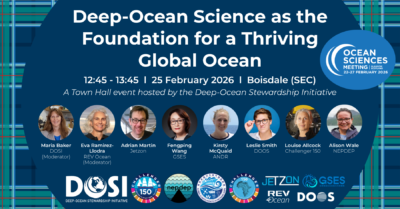
Deep-Ocean Science as the Foundation for a Thriving Global Ocean (TH33F)
DOSI is hosting a Town Hall focused on the essential role of deep-ocean science in underpinning a healthy, resilient, and productive global ocean. This session will bring together researchers, policymakers, and practitioners to discuss how deep-ocean knowledge supports effective ocean governance, informs international agreements, and enables sustainable management across areas within and beyond national jurisdiction.
The Town Hall will provide space for open discussion, community exchange, and identification of priorities for advancing deep-ocean science in support of global ocean goals.
Deep-Ocean Sessions at OSM 2026
OSM 2026 features a strong programme of sessions relevant to the deep-ocean community, including several convened or supported by DOSI working groups and members:
- Climate Change in the Deep Sea: Impacts, Interventions, and Cumulative Stressors (CC14B): Convened by the DOSI Climate Change Working Group, this session explores how climate-driven changes interact with other pressures in deep-sea ecosystems.
- Seamounts at the Nexus of Ocean Science (DS21A & DS24A): Convened by the DOSI Fisheries Working Group, these sessions highlight the ecological, biogeographic, and management importance of seamounts.
- Creating Deep Impact: Strategic Alignments Across Deep Ocean Observing, Modelling, Exploration, and Technology (DS14A, DS31A & DS33A): Sessions focused on strengthening coordination across deep-ocean research infrastructures and approaches.
- From High Seas to EEZs: The Role of Deep-Sea Science in Shaping Knowledge-Based Ocean Policy Decisions (DS34A): Examining how deep-sea science informs policy across jurisdictional boundaries.
- Environmental Impacts of Deep-Sea Mining (HC34C & HC51A): Addressing scientific evidence, uncertainties, and policy relevance related to seabed mining activities.
- The Deep-Pelagic Realm as a Nexus for Ecological Connectivity (ME24D): Exploring connectivity across depth zones and ecosystems.
- Making the Invisible Visible: Communicating and Advancing Capacity of Overlooked and Undervalued Ocean Science (ED12A & ED14B): Sessions focused on science communication, equity, and capacity development.
- Applying GIS to Analyze and Communicate Ocean Conditions (DO24A): Showcasing tools to support analysis and decision-making.
- FathomNet: Accelerate Analysis of Ocean Visual Data (TH43D): Highlighting advances in image-based deep-ocean data analysis.